
FAMILY CAREGIVING · FALL 2026
For families of older adults — and for the older adults who’d rather not be fussed over
A guide for families in Oregon and Washington
The first Sunday in November arrives every year with a shrug. Turn the clocks back, get an extra hour, move on. But that extra hour is never quite free. It lands on the shortest, darkest stretch of the year, and it lands hardest on the people whose bodies and routines have the least slack in them — older adults, and especially anyone already living with memory loss.
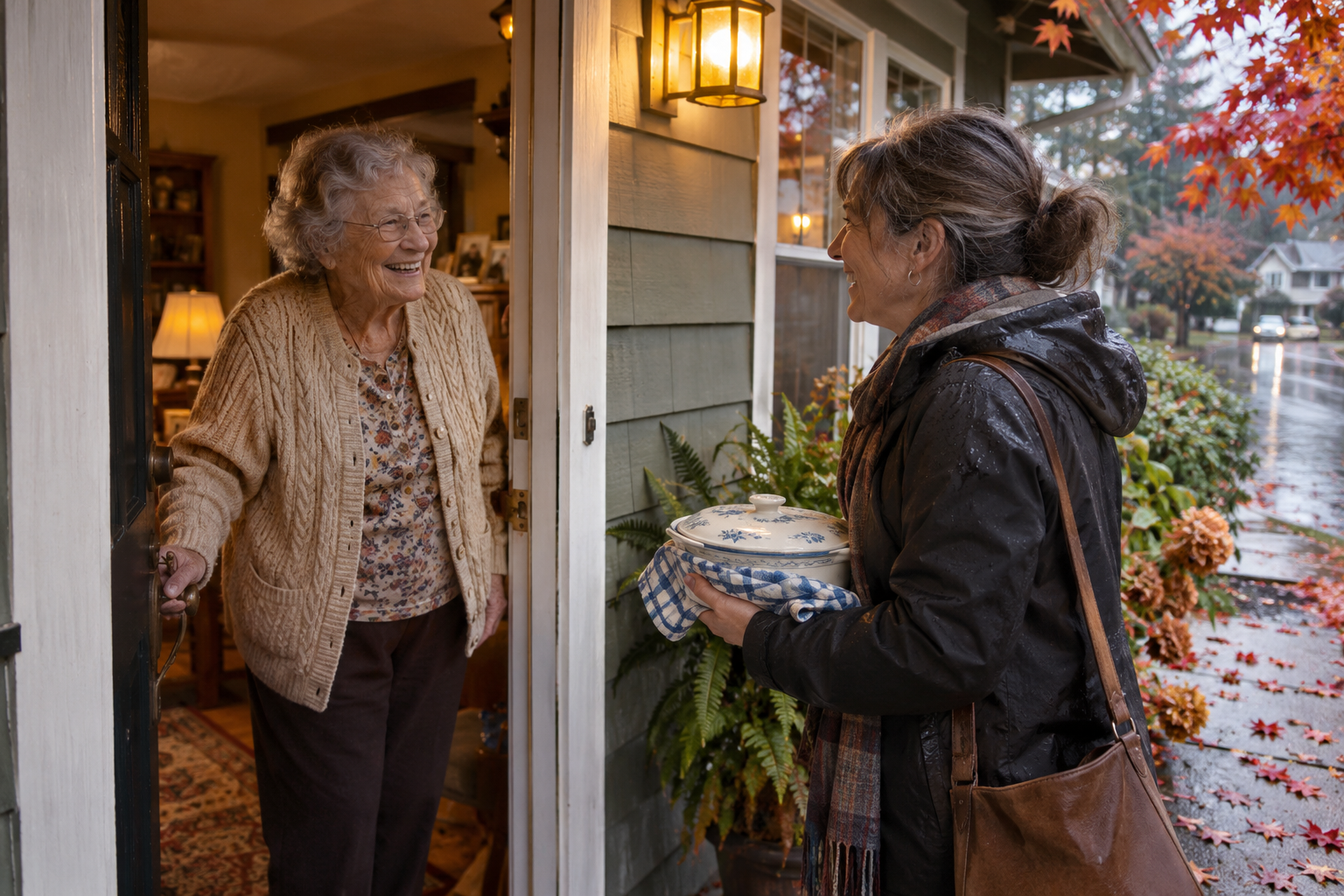
Here’s the other thing about this season. It’s when a lot of adult children go home for the holidays and see things they can’t unsee. The pill bottles in a jumble. The stack of unopened mail. The bruise nobody mentioned. The same story three times in an hour, told with the same delight each time.
If that’s you — if you’re reading this with a knot in your stomach — take a breath. You are not late, and you are not the first family to stand in this particular hallway. Millions of people are standing in it right now. Some of them have been standing there a while and just needed someone to say: here’s what to look for, here’s who to call, and here’s how to do it without making your mother feel like a problem to be solved.
Why the time change matters more than it seems
Sleep is the scaffolding under everything else. Cognitive function, mood, balance, blood pressure, pain tolerance, appetite — all of it sits on top of the sleep-wake cycle. Older adults already sleep lighter and wake more often. A one-hour shift in the clock is a one-hour shift in light exposure, medication timing, meal timing, and the cues the brain uses to know what day it is.
For someone with Alzheimer’s or another dementia, the effect can be sharper. Shorter afternoons mean more hours of darkness, and darkness is the classic trigger for sundowning — late-day confusion, restlessness, agitation, shadowing, and sometimes real fear. The Alzheimer’s Association notes that the shift in sunset time can be genuinely disorienting.1
Add the practical stuff that comes with the season: slick sidewalks, early dusk on the drive home, furnace and space heater season, holiday scammers on the phone, and a calendar full of disrupted routines. It’s a lot of small stressors landing at once. That’s why this is a good week to pay attention — not because the clock is dangerous, but because it’s a natural stress test, and a natural excuse to check in on someone you love.
You’re in very ordinary company
About 7.4 million Americans age 65 and older are living with Alzheimer’s in 2026 — roughly 1 in 9 people in that age group.2 More than 12 million family members and friends are providing their unpaid care, some 19.6 billion hours of it in 2025, worth an estimated $446 billion.3
Which is to say: whatever you’re seeing, someone else has seen it. Whatever decision you’re dreading, thousands of families made it last month and most of them came out the other side. That’s not a platitude — it’s a map. There are people who do this for a living, and they are kind and they are free to call.
Normal aging, or something more?
Forgetting a name and finding it twenty minutes later is Tuesday. Forgetting that the name belongs to your own son is a different category.
| Ordinary aging | Worth a closer look |
|---|---|
| Losing keys, then retracing steps | Losing keys and putting the milk in the cabinet |
| Forgetting an appointment | Missing appointments and denying they existed |
| Slower to learn new tech | Can’t operate the TV remote she’s used for years |
| Occasional word hunt | Sentences that trail off mid-thought |
| Preferring familiar routines | Getting lost on a familiar route |
| Needing a list at the store | Paying the same bill twice, or not at all |
| Being tired by 8 p.m. | Wide awake and agitated at 2 a.m. |
| Mild crankiness | New suspicion, apathy, or personality that seems off |
One item alone means little. A pattern across categories, worsening over weeks, means something.
The specific things to watch for
Memory and thinking. Repeated questions in a short window. Stories that get vaguer or more grandiose. Difficulty following a recipe or a news article. Trouble finding words for ordinary objects.
Daily function. Unpaid bills, duplicate payments, unopened statements, strange purchases. A checkbook that no longer balances. Pans left on the stove. The same clothes for four days. Spoiled food in the fridge and little in it that’s fresh.
Home and safety. New dents on the car. Mail piled up. Untended plants, unshoveled walk, burned-out bulbs. Rugs curling at the corners. Grab bars missing in a bathroom that needs them. Medications doubled up or skipped. A pill organizer still full from last week.
Mood and personality. Withdrawal from church, card club, the neighbors. Flatness. Irritability that’s new. Suspicion about money. Loss of interest in things that were the whole point of them.
Money and paperwork. This is where decline gets expensive fast. Missing a Medicare open-enrollment window, forgetting to file taxes, a “grandchild” calling from jail needing gift cards.
Late-day changes. Watch specifically between 3 and 7 p.m. Confusion that’s worse then and better in the morning is a signal, not a coincidence.
How to check in without insulting anybody
The core problem, and it’s a tender one: the person who most needs help is often the person least interested in being helped, and every offer can sound like a verdict. “Do you need help with that?” translates in their head to “you’re slipping.” Underneath the bristling is usually fear. Nobody wants to be the one who gets managed. So the goal isn’t to win the assessment — it’s to make it safe to be honest.
Lead with your own limitations, not theirs. “I’m trying to get better about seeing you — can I come by Sunday?” beats “I’m worried about you alone.”
Ask them to teach you something. People defend their competence when given a chance to display it. Ask for the recipe, the garden advice, how they met. Then ask what’s been harder lately.
Notice out loud, without a diagnosis attached. “I see the mail’s stacking up — is that just the season, or is it getting away from you?” Then stop talking.
Do the chore alongside, not instead. Cook together and let them run the stove while you chop. Sit in the passenger seat on the way to the store.
Small moves that don’t feel like supervision: bring food, and enough that some goes in the freezer. Ask to use the bathroom, then look at the bathroom. Walk to the mailbox with them. Snap photos of the fridge, the pill shelf, and the front steps. Bring a grandchild or a dog — nobody performs for a dog.
When they get defensive — they will — don’t argue. “That’s fair. Can we keep an eye on it and talk again in a month?” Defensiveness is not refusal. It’s usually fear. Give it somewhere to land and it softens. Come back in a month, as promised, and they’ll remember that you did.
What to do with what you learn
Write it down. Dates, what you saw, what they said. A two-month log is worth more to a doctor than anyone’s impression. Photograph the medication shelf and the mail pile.
Go to the appointment. Offer to come along “to help remember what the doctor says.” Ask for a medication review every visit; interactions and over-sedation cause a startling share of “dementia” symptoms that turn out to be fixable. Ask for a cognitive screen by name. Rule out the reversible first: B12, thyroid, depression, sleep apnea, hearing loss, urinary infection, dehydration.
Get the paperwork done while things are still easy. Durable power of attorney for finances, health care power of attorney, a HIPAA release, a will. An elder law attorney is worth the fee. In both Oregon and Washington, the local Area Agency on Aging can point to low-cost legal clinics.
Do the driving conversation properly. Don’t lead with the license. Ask them to drive you somewhere and observe: lane drift, tailgating, missed signals, hesitation at left turns. A formal driving evaluation through a rehab hospital or occupational therapist is neutral ground and takes the fight out of it.
Who to call
You don’t have to invent this from scratch. There is a whole infrastructure out here, and it’s free.
Alzheimer’s Association 24/7 Helpline: 800-272-3900 (alz.org). Staffed around the clock by specialists and master’s-level clinicians. Referrals, caregiver support groups, free classes, and the ALZNavigator planning tool. Call before there’s a diagnosis if you need to.
Alzheimer’s Foundation of America: 866-232-8484 (alzfdn.org). Licensed social workers, plus text and web chat in 90+ languages.
Oregon: ADRC of Oregon — 855-673-2372 (adrcoforegon.org). Connects you to your local Area Agency on Aging: in-home services, transportation, meals, respite, caregiver support, adult day programs.
Washington: DSHS Aging and Long-Term Support Administration (dshs.wa.gov/adult-and-aging-services). Home and Community Services offices, COPES waiver eligibility, adult family home licensing, and local resource contacts by county.
Eldercare Locator: 800-677-1116 (eldercare.acl.gov). Nationwide routing to local aging services.
211 (dial 2-1-1). Twenty-four hours, confidential, all languages.
VA Caregiver Support Line: 855-260-3274. Also ask about Aid & Attendance, a pension benefit for eligible wartime veterans and surviving spouses — routinely unclaimed.
Also: the primary care doctor, a geriatrician if you can get one, a care manager, the hospital social worker, and — importantly — a support group. Caregivers who join one make better decisions and last longer.
The care conversation
When. Don’t wait for a formal summit. Start early and small, and talk about it before it’s needed. The best time is roughly when the person can still weigh in meaningfully.
How. Frame it as wanting to know, not to decide. “If there ever comes a day when the house gets to be too much, what would you want? What would make it feel like yours?” Ask about the house specifically, not about their decline. Talk about their neighbor’s move rather than theirs.
What to cover
In-home care — companion and homemaker help versus hands-on personal care from a home health aide. Private pay, national median $35-$55 an hour.4
Adult day programs — structured days, meals, supervision. National median $95 a day, sometimes subsidized through the Area Agency on Aging.4
Adult foster homes (Oregon) and adult family homes (Washington) — a handful of residents in a residential setting, licensed by the state. Often the most homelike and least expensive licensed option, and hard to find without help.
Assisted living — apartment-style, meals, medication management, help with bathing and dressing. Private pay, national median $6,200 a month.4 Oregon median is about $7,000 a month.
Memory care — secured units with dementia-specific staff and programming.
Continuing care retirement communities — buy in while independent, step up through levels of care on one campus. Rewards early planning, punishes waiting.
Skilled nursing — clinical needs, rehab or long-term custodial care. National median $9,581 a month for a semi-private room.4
Money, honestly
Medicare covers rehab and doctor care, not long-term custodial care. Medicaid does, once assets are spent down — and both states apply a five-year look-back on asset transfers, so gifts made in a hurry can create a penalty later.5
Washington adds a state benefit worth knowing: the WA Cares Fund, a public long-term care insurance program funded by a 0.58% payroll contribution, providing a lifetime benefit of up to $36,500 (indexed) to workers who meet the contribution and care-need tests. Benefits became available statewide July 1, 2026. Info: 844-227-3492, wacaresfund.wa.gov.6
Oregon has no equivalent wage-funded benefit, but does have Oregon Project Independence, which provides in-home services to older adults who aren’t Medicaid-eligible, on a sliding-fee basis, through the Area Agencies on Aging.
Also: long-term care insurance if they have it (call the insurer now, not during a claim), VA benefits, life insurance conversions, and a reverse mortgage, carefully. This is where an elder law attorney earns their fee.
Then go look. Tour two or three places before you need one with the help of a Senior Living Advisor. Have lunch there. Ask about staff turnover, weekend staffing ratios, and what happens when a resident’s needs increase. A tour taken calmly is worth ten taken in a panic.
The person who does this work for a living!
Here’s something most families don’t learn until it’s too late: there are professionals whose entire job is to make this search bearable, and in most cases they cost you nothing.
A senior living advisor — sometimes called a placement advisor or referral or placement agent— is a local, state-registered agent (who must meet strict state expectations and background checks) who learns what your parent actually needs and what they’d actually want, then does the legwork. For instance, they know how to locate complaints, which communities have memory care that isn’t a locked hallway with a TV, which ones have staff who’ve stayed five years, which ones will take a couple together when one needs far more care than the other, which have a bed this month and which have a two-year list.
Integrity Senior Living Advisors is that kind of agency — state-registered, based in Canby, Oregon, serving most of Oregon, with more than 35 years of combined experience on the team (integritysenioradvisor.com). Their process is deliberately unhurried: a phone consultation, an in-person meeting where they come to you, advisor-accompanied tours of a short list built around your family’s budget and location, then help coordinating the move itself, including referrals to movers and downsizers in collaboration with the community of choice. They also refer to quality in-home care agencies, respite care, and hospice services when the need is different than a move.
Why this is a life changer, in plain terms:
It collapses the research. Most families start with forty browser tabs and no way to tell which places are actually good. An advisor has already been inside all of them.
It absorbs the phone calls. Availability checks, pricing questions, callbacks. You get a short list instead of a spreadsheet.
It takes the fight out of the room. A neutral professional asking your father what he wants carries different weight than his daughter asking.
It holds up when the search gets hard. One Integrity client needed a home for both parents together, with advanced dementia and mobility needs on one side — a request that closed door after door. The advisor kept going until she found the right place.
It’s free to you. Advisors are compensated by communities, not by families, typically a percentage of the first month’s rent. Ask any advisor to explain their fee structure in writing and how many communities they represent. A good one hands you the disclosure without being asked. Integrity publishes theirs.
Reach an Integrity team member at 503-217-4097 or through integritysenioradvisor.com/contact-intake.
Even if you’re a year from needing anything, an early conversation gives you a waiting-list strategy instead of an emergency.
Why waiting for a crisis is the expensive choice
It feels prudent to wait. It feels like respecting independence. Sometimes it is. But a crisis isn’t a softer version of a planned move — it’s a different, worse event. The crisis usually looks like this: a fall with a hip fracture. A car accident. A stove fire. A wandering episode at 10 p.m. in a bathrobe. A urinary tract infection that tips into delirium. A scam that drains an account. A caregiver’s own heart attack.
What follows is the part people don’t anticipate.
Emergency rooms and hospital delirium. Roughly one in five hospitalized older adults develops delirium, and it’s frequently missed — in one cohort, only 8% of cases were noted in the discharge summary.7 Delirium is associated with measurable cognitive decline after discharge.8 Some people leave the hospital substantially worse than they arrived.
Falls, which are not minor. More than one in four older adults falls each year — over 14 million people — and 43,020 died from preventable falls in 2024.9 Most of the hazards behind those falls cost under $200 and a weekend to fix.
Placement by default. You take the bed that’s open tonight, not the one you researched in March.
Money. Emergency respite, round-the-clock private aides, hospital bills, home modifications done in a hurry, a deposit chosen under duress.
Exploitation. Isolation plus confusion plus a phone is a scammer’s ideal client. Americans 60 and older reported $7.75 billion in internet crime losses in 2025 — a 59% jump in a single year.10
Caregiver collapse. The daughter who “just handles it” until she doesn’t. Burnout isn’t a personality flaw; it’s a predictable load failure.
Lost choices. The person’s own preferences get overwritten by whoever’s in the room when it breaks.
Planned moves go better on every measure: better fit, better timing, less trauma, and a person who arrives with some say in the matter.
What good planning actually looks like
It is not a stack of brochures. It’s unglamorous, and it’s mostly cheap:
- A current medication list in a wallet and a photo on your phone
- Grab bars, night lights, a shower chair, a stair rail, rugs taped down, a stove auto-shutoff knob
- A key safe or a spare key with a neighbor, so an EMT doesn’t break the door
- Bills on autopay, and a second set of eyes on the account
- A medication organizer filled once a week, together
- Written down: doctors, pharmacy, insurance, attorney, neighbors, the safe’s combination
- Paperwork signed: POA, health care POA, HIPAA release
- A named person on the facility’s and the pharmacy’s contact list
- One tour taken, one waiting list joined, one support group attended, one advisor met
- A holiday plan that includes a real conversation, not just a real meal
Families who do this describe the same shift: the visits stop being audits and go back to being visits. The worry drops from a roar to a hum, because there’s a plan and it’s written down.
This week
Not all of it. Just this:
- Call or stop by. Bring something to eat.
- Walk to the mailbox together and look at the steps and the light.
- Ask for a story, then ask what’s been harder lately.
- Photograph the pill shelf and the mail pile.
- Put 800-272-3900 and your local ADRC number in your phone.
And if you already know, in the wordless way people know things, that this season is going to end with a decision — make one call this week that isn’t to your parent. Make it to a doctor, to an advisor, to a support group. Make it for you.
The clock change will pass in a week or two. The window it opens is worth more than that.
You’ll get some of this wrong. Everyone does. Maybe your parent will be prickly and you’ll be tired and somebody will say “I’m fine” through a closed door. Go back anyway. That’s the whole job, and you’re already better at it than you think.
Tear-off resource card
Keep this on the fridge or in a wallet. Nothing here costs money to call.
| Alzheimer’s Association, 24/7 | 800-272-3900 |
| Alzheimer’s Foundation of America | 866-232-8484 |
| ADRC of Oregon | 855-673-2372 |
| WA DSHS Aging & Long-Term Support | dshs.wa.gov/altsa |
| Eldercare Locator | 800-677-1116 |
| 211 (all languages, 24 hr) | 2-1-1 |
| VA Caregiver Support Line | 855-260-3274 |
| WA Cares Fund | 844-227-3492 |
| Integrity Senior Living Advisors | 503-217-4097 |
| Emergency — sudden confusion, fall with head strike, can’t speak or move | 911 |
Sources
- Alzheimer’s Association, “Daylight Saving Time and Alzheimer’s,” alz.org/gmc/news/daylight-saving-time-and-alzheimer-s
- Alzheimer’s Association, 2026 Alzheimer’s Disease Facts and Figures, alz.org/alzheimers-dementia/facts-figures
- Alzheimer’s & Dementia (2026), doi:10.1002/alz.71345 — unpaid caregiver hours and value
- CareScout, Cost of Care Survey 2025 (released March 2026), carescout.com/cost-of-care — national medians, July–November 2025 data
- Medicaid 60-month look-back on asset transfers, medicaidplanningassistance.org/medicaid-look-back-period
- WA Cares Fund, wacaresfund.wa.gov — contribution rate, benefit amount, care-need test, benefit availability
- BMC Geriatrics (2025), doi:10.1186/s12877-025-06903-8 — delirium prevalence and underdiagnosis
- Age and Ageing (2025), doi:10.1093/ageing/afaf188 — delirium and post-discharge cognitive decline
- CDC, “Older Adult Falls Data,” cdc.gov/falls/data-research — 2024 fall deaths, 1-in-4 prevalence
- FBI Internet Crime Complaint Center, 2025 Annual Report, ic3.gov — 60+ complaints and losses
Accuracy, scope, and disclosure
Scope. Written for readers in Oregon and Washington. Cost figures are national medians from the CareScout 2025 survey; Oregon and Washington both run above the national median in most care categories, so local quotes will be higher. Verify current numbers before relying on them.
Currency. All figures reflect sources available as of November 2026. Program rules, benefit amounts, and eligibility thresholds change — particularly WA Cares, which is subject to legislative amendment. Confirm with the administering agency before acting.
Not advice. This article is general information, not medical, legal, tax, or financial advice, and not a substitute for a clinical assessment or an attorney’s review. Nothing here creates a professional relationship. Individual circumstances vary.
No guarantees. Statements about outcomes of planning, advisor services, or specific care settings describe what commonly happens, not what will happen. Testimonials are the clients’ own words and are not typicality claims.
Disclosure. Integrity Senior Living Advisors is a state-certified placement and referral agency compensated by communities rather than by client families, and is the subject of the advisor section. Other organizations named are unaffiliated. No other compensation was received for inclusion.
Oregon and Washington notes. Care settings are state-licensed: adult foster homes by the Oregon Department of Human Services, adult family homes by the Washington Department of Social and Health Services. Licensing verifies minimum standards, not quality. Ask for a community’s most recent inspection report from the licensing agency. Medicaid long-term care eligibility differs by state and is administered by ODHS in Oregon and DSHS in Washington.
How we fact-check
Every statistic in our articles links to its primary source — a government agency, peer-reviewed journal, or named survey — with a date. Cost figures are labeled national or regional and dated to the survey year. Program rules and phone numbers are verified before publication and re-checked quarterly. Written by our advisors for Oregon and Washington families. General information, not medical or legal advice. Spot an error? Call 503-217-4097 or email theresa@integritysenioradvisor.com.
Last reviewed: November 2026 ·
Revision log: v1.0, November 2026 — original publication.
Published November 2026. © Integrity Senior Living Advisors, 358 NW 1st Ave #5, Canby, OR 97013. May be reprinted by senior centers, churches, and clinics with attribution.